You Can Pay for Anything With Your Stablecoin in Africa. You Just Did Not Know It Yet.
Amara gets paid in stablecoin every month. She pays school fees, flights, utilities, food, and clothing. Every single payment still goes through P2P first. That ends now.
Amara is a UX designer based in Abuja. She works remotely for a startup in Amsterdam. Her salary lands in stablecoin every last Friday of the month. She has been receiving crypto for two years now and she manages it well. She knows her rates. She tracks the market. She understands the difference between networks.
But here is her month in payments.
She pays school fees for her younger brother in Enugu. She books domestic flights twice a month between Abuja and Lagos for client meetings. She pays for her apartment utilities, electricity and water. She subscribes to online learning platforms to stay sharp in her field. She orders food three or four times a week. She buys clothes every other month.
Every single one of those payments requires her to go through P2P first. Find a buyer. Negotiate. Wait. Receive naira. Then pay. For every single category. Every single time.
Amara is not an edge case. She is the average African crypto holder. And she has been operating this way because nobody told her there is another way. Nobody built the other way. Until now.
Stablecoin is not just a trading asset in Africa. For millions of people, it is the primary way they receive and hold value. The question was never whether they would use it. The question was what they could use it for.
The Assumption That Was Always Wrong
For a long time the assumption in the crypto industry was that people in Africa were using crypto primarily to speculate. Buy low, sell high, repeat. The data told a different story.
Nigerians and other Africans adopted crypto because they needed a better way to receive international payments, store value against currency devaluation, and move money across borders without being bled dry by bank fees. They were not speculators. They were practical people solving practical financial problems.
But the infrastructure built around them treated them like speculators. Exchanges. Trading pairs. Charts. Order books. None of it was designed for someone who wants to pay school fees with stablecoin.
The result is a generation of Africans who are financially sophisticated in the crypto world and still stuck doing everything the old way when it comes to spending.
What Your Stablecoin Can Actually Pay For
Let us be specific because this is where most people are still surprised.
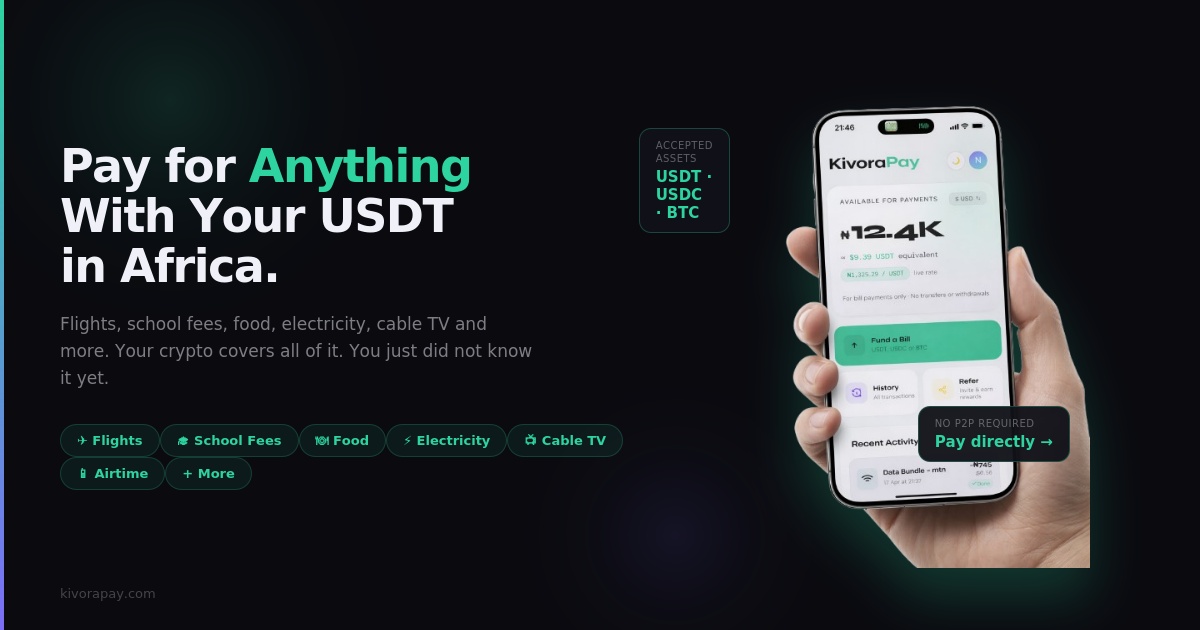
Your stablecoin can pay for flights. If you have ever booked a domestic or international flight in Nigeria you know the process. You go to a booking platform, you see the price in naira, and then you try to figure out how to pay because your card may not work internationally and your naira account may not have the right balance. With KivoraPay you send USDC and the booking is processed. No naira conversion on your end. No card issues.
Your stablecoin can pay school fees. University fees, polytechnic fees, private school fees. Education is one of the biggest expenses in the average Nigerian household and it is almost always paid in lump sums that people scramble to gather. If your income is in USDC, paying education fees directly without the P2P detour removes a significant amount of stress from that process.
Your stablecoin can pay for food. Not in a theoretical future sense. Right now. If you order food regularly, which most working professionals in Lagos, Abuja, and Port Harcourt do, you can use your USDC balance to pay for that order directly. No conversion. No waiting. Your crypto becomes your dinner.
Your stablecoin can pay electricity. Yes, the classic use case. But it is worth mentioning because electricity payment is the most frequent recurring payment in most Nigerian households and every time someone has to go through P2P to pay it, they are losing time and sometimes money to rate spreads.
Your stablecoin can pay for cable TV. Your DStv or GOtv subscription. Airtime. Data bundles. Betting accounts. And as the platform expands, clothing, government services, and more.
The question is not whether your stablecoin can cover your life. It can. The question is whether the infrastructure exists to make it seamless. That infrastructure now exists.
Why Nobody Built This Before
The honest answer is that building payment infrastructure is hard. It requires relationships with licensed payment providers, regulatory awareness, and a deep understanding of local biller systems. A startup building a crypto trading app does not need any of that. A startup trying to connect your stablecoin to your electricity distribution company does.
Most crypto startups took the easier path. Build an exchange. Build a wallet. Build a trading interface. These are real products and they serve real purposes. But none of them solve the last mile problem. None of them close the gap between holding crypto and spending it on the things that actually matter in daily life.
KivoraPay was built specifically to close that gap. Not by building another exchange or wallet but by building the bridge between the crypto ecosystem and the licensed payment infrastructure that powers everyday life in Africa.
How It Actually Works
The flow is simpler than most people expect. You open KivoraPay and choose what you want to pay for. A flight. School fees. Food. Electricity. Whatever it is. You enter the relevant details and see the exact amount in stablecoin required for that payment.
Then you have three options. You can scan a QR code from your exchange app or crypto wallet. You can tap a deep link that opens your wallet app with the payment pre-filled. Or you can copy the address and amount and send manually.
The key thing to note is that you send from wherever you already hold your stablecoin. Bybit, Binance, OKX, Phantom, Trust Wallet. As long as you select Solana as the network when sending, the payment arrives at KivoraPay, gets processed, and your bill is paid. You get a confirmation with the transaction details and a Solana transaction ID you can verify on-chain.
No P2P marketplace. No waiting for a buyer. No negotiating a rate. No naira transfer to your bank before you can pay. Just send and done.
What This Means for How You Think About Crypto
There is a mindset shift that happens when you realise your stablecoin can actually cover your life. You stop thinking of it as an asset you have to convert before you can use it. You start thinking of it as money that works directly.
That shift matters more than it might seem. It changes how you receive payments. It changes how you budget. It changes what you ask for when clients offer to pay you. If your stablecoin can pay your rent, your school fees, your groceries, your flights, your utilities, and your subscriptions, then receiving in stablecoin is no longer a convenience. It is your primary financial operating system.
This is where financial infrastructure for Africa should have been years ago. The adoption happened early. The spending layer is arriving now.
The average African crypto holder is not waiting to enter the financial system. They built their own. What they needed was the infrastructure to make that system work for everything, not just trading.
Starting With Nigeria, Built for Africa
KivoraPay is live in Nigeria, but the vision is not Nigeria-specific. Ghana, Kenya, South Africa, and every other African market where crypto has become a meaningful part of how people manage money is part of the roadmap.
The categories will expand. The countries will expand. The providers will expand. But the core idea stays the same. If you hold crypto in Africa, you should be able to use it to pay for your life. Not just the easy parts. All of it.
Amara in Abuja should not have to go through P2P every time she needs to pay her brother's school fees. A trader in Lagos should not have to convert before booking a flight. A freelancer in Port Harcourt should not lose twenty minutes and a rate spread every time they want to order food.
The infrastructure exists now. The only thing left to do is use it.
KivoraPay lets you pay for flights, school fees, food, electricity, airtime, cable TV and more directly with your Stablecoin or Bitcoin. Send from any exchange or wallet on Solana. No P2P. No conversion stress.
Get Started Free