Spend From Your Crypto Wallet. Avoid the P2P Stress and Exchange Fees.
Your USDT is sitting in Bybit right now. A flight to Accra. School fees due Friday. Dinner tonight. A customer invoice. Why can't it just work directly?
Open your Bybit app. Go to assets. Your USDT balance is sitting there. You earned it. You saved it. You know exactly what it is worth today.
Now you need to pay for something. A flight to Accra next week. Your daughter's school fees are due on Friday. Your electricity token before the unit finishes. Dinner tonight because you have been working since 7am, and cooking is not happening.
Here is the question nobody has asked loudly enough. Why can't that USDT just pay for those things directly?
Not through P2P. Not by first finding a buyer, negotiating a rate, waiting thirty minutes for naira to land in your account, and then making the payment. Directly. The way money is supposed to work.
Until recently, the honest answer was that the infrastructure did not exist. Now it does.
Your USDT should work like money. Not like an asset you have to liquidate before you can use it. The difference between those two things is the infrastructure that was missing.
The Real Cost of P2P as a Payment Method
Most people who use P2P regularly have stopped counting what it actually costs them. The friction has become background noise. But if you sit down and actually calculate it, the numbers are uncomfortable.
Take time first. A typical P2P transaction from opening the app to receiving naira in your bank takes between fifteen and forty-five minutes, depending on how fast the buyer responds and how quickly the bank transfer processes. If you make eight to ten bill payments a month across electricity, airtime, data, cable, food orders, and other expenses, you are spending two to seven hours every single month just on the conversion step. That is time you are not working, not resting, not doing anything useful. You are sitting in a waiting room that should not exist.
Then there is the rate. P2P buyers are also trying to make money. The spread between the real market rate and what you get on P2P is typically one to three percent per transaction. On a $500 USDT monthly spend, that is five to fifteen dollars lost every month to rate spreads. Over a year, that is sixty to a hundred and eighty dollars. That is real money that belongs in your pocket.
Then there is the risk. Most P2P transactions complete without incident, but the ones that do not are genuinely painful. Scams happen. Delayed transfers happen. Disputes happen. Every transaction carries a small probability of going wrong, and when it does, the resolution process is slow and stressful.
And finally, there is the cognitive load. Having to think about finding a buyer, checking rates, timing your conversion, and managing the process for every single payment is mentally exhausting in a way that is hard to quantify but very real.
What Paying Directly Actually Looks Like
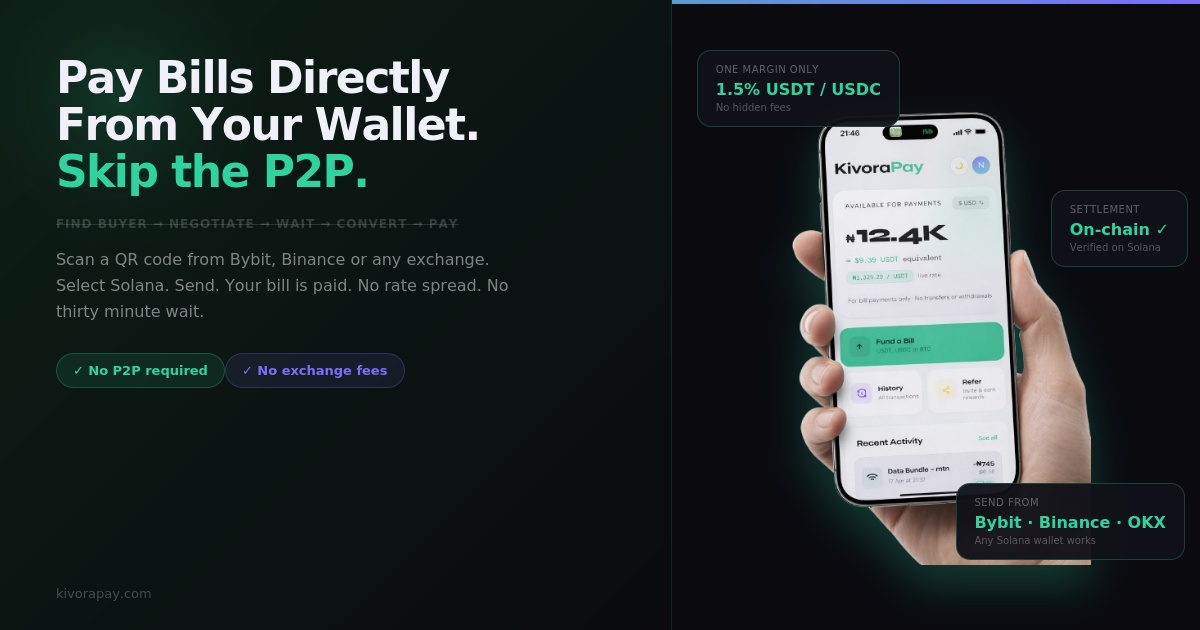
Here is what the same process looks like when you pay directly from your crypto wallet through KivoraPay.
You open KivoraPay and select what you want to pay for. Let us say it is a domestic flight from Lagos to Abuja. You enter your travel details. KivoraPay shows you the naira price of the flight and the exact USDT equivalent. No hidden fees. No surprises.
A payment screen appears with three options. A QR code you can scan from your Bybit or Binance app. A deep link that opens your Phantom or Trust Wallet directly with the payment pre-filled. Or a copy-and-paste option for the address and amount if you prefer to do it manually.
You open Bybit. Go to withdraw. Select USDT. Select Solana as the network. Scan the QR code. The address and amount fill automatically. You confirm and send.
KivoraPay detects your payment on the Solana blockchain within seconds. Your flight booking is processed. You receive a confirmation with your booking reference and a Solana transaction ID you can verify independently.
Total time from opening KivoraPay to confirmed booking: under three minutes. No buyer search. No negotiation. No waiting for naira. No second app for the payment. Just done.
Three minutes versus forty-five. That is the difference between infrastructure that works and infrastructure that was never built for you.
Every Category. Not Just Electricity.
One of the most common misconceptions about crypto bill payments is that it is limited to the basics. Electricity and airtime. Those are important but they are only the beginning of what your USDT can cover.
Flights and travel. Book domestic and international flights directly with your USDT. For anyone who travels regularly for work or family, this is one of the most valuable use cases. No more scrambling for dollar cards that may decline. No more naira conversion at a bad rate before booking.
School and education fees. University fees, polytechnic payments, private school tuition, professional course subscriptions. Education expenses in Nigeria are significant and they come in large lump sums that crypto holders often have in USDT but cannot use directly. That changes now.
Food and dining. If you order food regularly through delivery platforms you know how the payment experience can be frustrating. KivoraPay connects your USDT to food payments so dinner tonight does not require a P2P transaction first.
Cable TV subscriptions. Your DStv, GOtv, or Startimes renewal. Small payment, recurring, easy to forget until your subscription cuts out mid-series. Pay it directly with your USDT without leaving the crypto ecosystem.
Airtime and data. The most frequent payment most Nigerians make. Still requires a P2P step for crypto holders today. KivoraPay removes that step.
Betting accounts. For users who fund betting wallets regularly, crypto direct payment removes the friction of the naira conversion step that currently sits between their USDT and their betting balance.
And the list is growing. Government payments, clothing and retail, and more categories are being added as the platform expands.
Sending From Any Exchange or Wallet
You do not need to move your crypto to a new wallet or platform to use KivoraPay. Whatever exchange or wallet you currently use is fine. Bybit, Binance, OKX, Coinbase, Phantom, Trust Wallet, Backpack. As long as you can send USDT, USDC, or Bitcoin on Solana, you can pay through KivoraPay.
The only thing to remember is to always select Solana as your network when sending. Sending USDT on Tron or Ethereum to a Solana address will result in funds not arriving. KivoraPay makes this clear at every step of the payment process with a prominent warning. But it is worth understanding: Solana network only.
Most payment platforms require you to hold funds inside their system before you can pay anything. KivoraPay lets you pay from wherever your crypto already lives. Your Bybit balance. Your Phantom wallet. Your OKX account. No pre-loading required.
What This Changes
When your USDT can pay directly for flights, school fees, food, electricity, subscriptions, and more, the way you think about your crypto income changes.
You stop treating USDT as an intermediate step on the way to naira. You start treating it as the actual currency your financial life runs on. You earn in USDT. You spend in USDT. The naira conversion happens in the background, handled by infrastructure you do not have to think about.
That is what a properly functioning payment layer looks like. Not P2P. Not exchange conversion. Not a thirty to forty-five minute process before every bill. A direct, fast connection between your crypto and the things you need to pay for.
The P2P stress ends. The exchange fee drain ends. The waiting ends.
Your USDT was always capable of paying for your life. The infrastructure to make it happen is now here.
KivoraPay lets you pay for flights, school fees, food, electricity, airtime, cable TV and more directly from your Bybit, Binance, Phantom, or any Solana wallet. No P2P. No exchange fees.
Get Started Free